
Issue 18: The green garment. A prelude to Slavic folk medicine.
On the metaphysics of color, schismatic dualism & the roots of vernacular healing

A fortnight ago, in Issue 17: Among animals and plants, I promised to carry on with the theme of “Why talk to the grasses?” and to tell you about the use of charms in our traditional herbalism and village medicine, known as znakharstvo. Why wasn’t it enough for our znakhars to harvest and make use of herbs, and why do we instead have a copious literature of herbal charms — words addressed to the plants themselves, as interlocutors and helpers possessed of their own free will?.. Dutifully, I pursued the topic of Old Words, realizing along the way that there isn’t a cut-and-dried way of explaining our herbal practices without taking a long detour into vernacular religion — that theory from which traditional practices spring up, not as superstitions, but as expressions of a shrewd and down-to-earth sensibility. I’m still intent on getting to that question of ritual speech, but if you wish to follow me towards its answer, I think, my dear reader, it might take some patience... Thank you, then, for that patience, for being here, and for all that I learn from you all as fellow writers, while writing for you these dispatches.
1.
In the French province of Ariège, not very far from where we’re now lodged among the curly green foothills of the Pyrenees, a cave embellished with some of the world’s earliest paintings is open to visiting by appointment-and-guided-tour. It is the cave of Niaux, one of the sites of Magdalenian cave art, scattered across today’s Spain and Southwestern France. Unlike Chauvet (Werner Herzog’s Cave of Forgotten Dreams), Niaux is still open to visitors. You can go there and see, first-hand, those forceful depictions of bison, horses, goats and lions, all painted in the depths of a mountain, by torchlight, some 20,000 years ago.
In all its expressive power, Magdalenian art relied on just three colors: white (not pure white, but the lighter unpainted ground of the rock face, “white” in the abstract sense of being blank); black (the majority of the markings on the walls); and occasionally an earthy red (particularly the multiple human hand-prints, sometimes the same hand imprinted again and again on the same wall, as if to commemorate every visit paid by to the cave by the hand’s owner).
White (or light), black (or dark), and red. A triad of colors that matches the earliest color terms to emerge in human language, as argued by the linguists Brent Berlin and Paul Kay of the so-called “Berlin-Kay color hierarchy” — a theory of sequential emergence of color terms across all human languages: starting with the first differentiation, of light against dark; followed by red; and next by green. These fundamental colors do not correspond, as you can see, to the optical “basic colors” red, yellow and blue. Apparently, these are instead the experiential and metaphysical basic colors — all other color adjectives emerging after these first four.
Here’s something curious. As late as Aristotle’s time, language was still considered a reliable reflection of metaphysical reality — which is why Aristotle built his Metaphysics so freely and unselfconsciously on the foundations of Greek grammar. Today, we may know nothing of the Magdalenian language, but the tricolor animal compositions in Magdalenian caves have a brusque eloquence that I can only describe as metaphysical, engaged in advancing a philosophy of the sacred, not less forcefully than say the Orthodox ikon tradition and its “argument through image.”
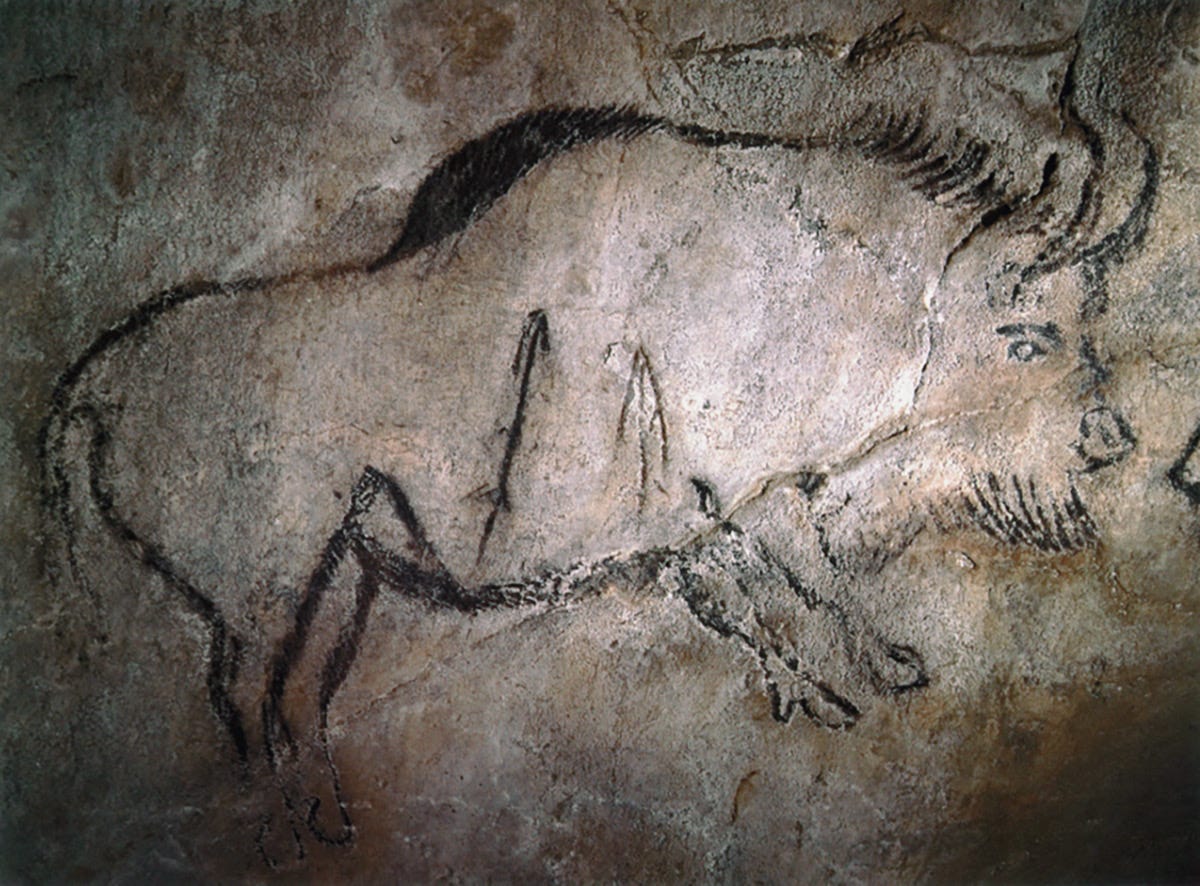
I speak of compositions, as opposed to individual animal depictions, because of a consistent pattern, or canon if you like, in Magdalenian art: the cave buffalo and bison always appear close to the cave ceiling; beneath the bison we see the goats, lions, and other animals, but not the horses; the latter appear closest to the cave floor. These tiers are not sharply demarcated; yet the relative position of the animals suggests an awareness of these distinguishable layers of existence, or perhaps three worlds: the world above (bison), the world below (horse), the world at eye-level. A structure entirely congruous with the earliest shamanic myths of Northern Europe.
The use of red is exceedingly spare, mostly reserved for the human hand-prints, as if to say that red is proper to the human and the world inhabited by people — the predominantly green world outside the cave. The world that appears in broad daylight as a sea of green, just outside the cave, is red when encountered within its tenebrous heart. It is the red-and-green world of the real.
2.
Kuzma Petrov-Vodkin, the painter perhaps best known for his Bathing of the Red Stallion (1912), gives a great deal of thought to color in his notebooks. He considered the color red — the optical complementary of green — to be something like the outer appearance of the green itself: “There is much that is paradoxical in the nature of color,” he wrote, explaining:
Consider this: We see a red object, but what exactly does this mean? It means that the object does not absorb but instead deflects all the red rays, whilst absorbing the blue and the yellow; and so it turns out that this object, while essentially green, cloaks itself, so to speak, in red.
In other words, the object “wears” a color complimentary to the color of the light it absorbs, while all that we see is only the reflected light that it repels. “Curiously,” Petrov-Vodkin points out, “it is exactly that inner color of the object that daltonists [the color-blind] do perceive.”
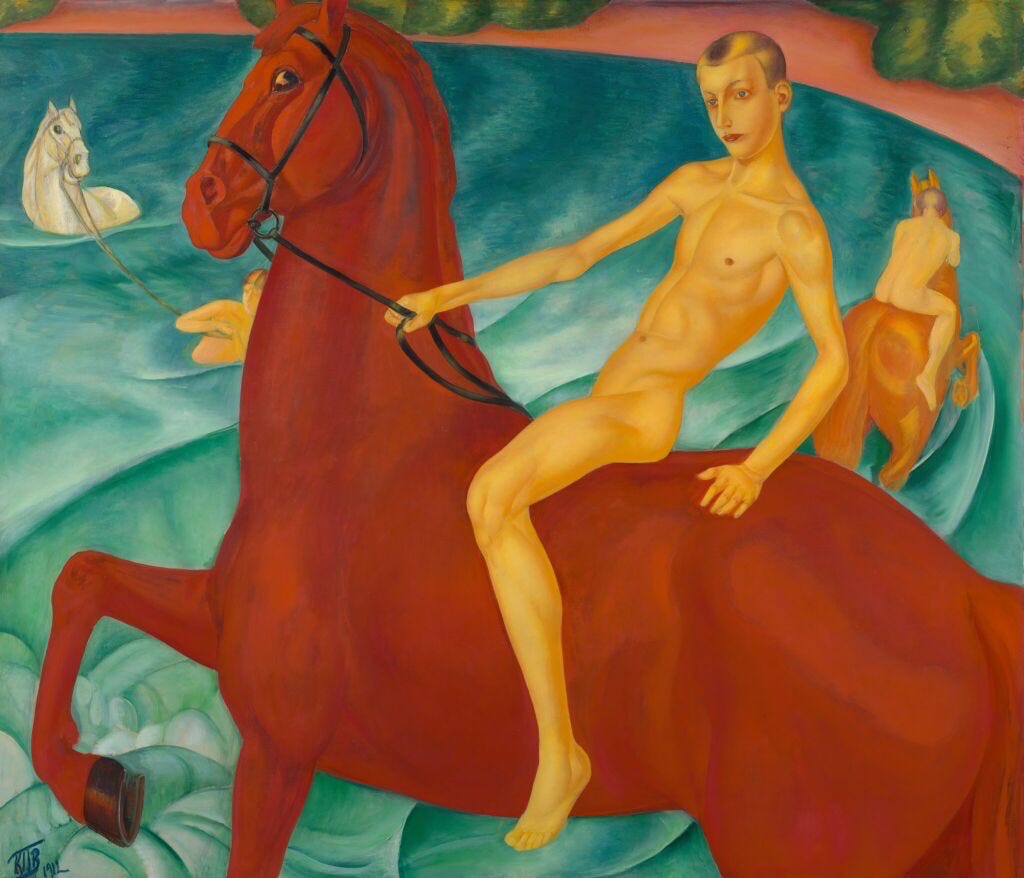
This interplay of the inner and the outer, appearance and reality, behind the interplay of complementary colors is very much Petrov-Vodkin — who painted the “red stallion,” that icon of Socialist Revolution, from an aged and wizened country mare, a horse completely broken down “in every leg” by years of hard work, except for its “good muzzle” (as jotted down in the artist’s notebook). There’s poignancy and metaphysical richness in this transformation, of a particular old mare into a universalized “red stallion” — a transformation also embodied in the red-and-green palette and everything it invites us to think about. Once again, very much like an ikon, the painting engages in a metaphysical polemic through visual image, and specifically through a color-language restricted to the fundamental values: light (absorbing nothing, deflecting all) and dark (absorbing all, deflecting nothing), red (absorbing the green) and green (absorbing the red).
And the subject of the polemic? I would say it’s the unity of opposites.
The two pairs of complementary colors amount to a pair of structural axes forming the symbolic crux of reality — the ancient figure of the cross that differentiates the Universe into four quadrants: the black Lower World; the white heavens of Navie; the red-and-green world of the senses — of reality and illusion (for the nag is inwardly a stallion, and vice-versa). Thus the four colors also stand for Earth and Air (dark and light), and Fire and Water (red and green), the Empedoclean elements.
Once the whole has been divided into four, life can begin its development. Four is the number of solid foundations, in cell biology just as in carpentry.
Four also corresponds to green, the fourth color-term to emerge, just as the impulse symbolized by the red requires another power that would sustain it. And that power revealed itself to Hildergard as viriditas — the sustaining green power of Life, the medicine that moderates, tempers, and restores the right measure.
The wreath of days
Slavic traditional calendar for June 12 – July 1, 2026
June 12–13: Waning Moon favors finishing projects, clearing away difficulties and obstacles, and parting with anything that burdens and holds us back. Also a good time for collecting medicinal roots.
June 14–16: In all Slavic cultures, the three moonless nights are considered a transitional time of New Moon, when all risk, as well as new beginnings, are generally avoided. An excellent time, nevertheless, for collecting edible roots — our znakhars say that plant power flows underground until the young crescent appears once again in the night sky.
From June 17 onward: Waxing Moon, coinciding with the final days leading up to Summer Solstice–Kupalo, the crown of summer and the peak of Nature’s powers. An ideal time to look into the near future — the remainder of summer and early September — bringing your hopes into focus and inviting Divine cooperation through your practice.
June 19: The evening descends into the Night of the Serpent, a dark and perilous night preceding the Eve of Kupalo — the Slavic Midsummer Night — the night following. A night for staying inside, deferring any risky or uncertain endeavors until later, practicing protection rituals or simply repairing anything at home that feels shaky or flimsy. Sorcerers use this night to make the traditional Kupavka doll, later to be floated downstream, carrying off sorrows and troubles.
June 20: Kupalnitsa during the day, and the Eve of Kupalo after sunset.
Kupalnitsa, the crown day of Summer, is the peak of the Herbalist’s season. During the day, women collect herbs and tree branches to be tied into besoms, saving up the wondrous powers of Summer’s peak for use in the dark time of the year. Besoms for the sauna are tied from birch, linden, and oak branches — not to mention the strong aromatic mugwort besoms (use with utmost caution, and much more on sauna and besoms in Issue 5.) Other herbs are bundled into smaller bunches for remedies, kitchen use, and for smoking the house and barn as needed.
The night of Kupalo — known throughout Europe for its bonfires and revelry amidst the woods and meadows — celebrates the mystical union of Fire and Water. Don’t miss this night while waiting for “St. John’s Eve” on June 23 (or even July 6, for the Eastern Orthodox), for there’s only one Midsummer Night in Nature — the eve of the Summer Solstice.
June 21: Kupalo Rosnoe (Kupalo’s Dewy Morning). Activity begins at dawn. Younger women come out into the meadows before sunrise, bathing in the dew amidst the grasses to “raise glory” (in other words, to heighten their power to entice the opposite sex). Delicate and fragile botanicals are to be collected before sunrise; other herbs at the peak of day, when the dew has dried. An important day of herbal harvest.
June 26: The eighth of the twelve Fridays of the year specially consecrated to Makosh, the Slavic Goddess of destinies and sacred sorcery. The perfect day for Seidr, or even just dreaming your intention into your spinning, embroidery, or another creation in fiber.
June 29 – July 1: Three nights that can all be treated as Full Moon for ritual purposes. Herbs at the peak of their magical and medicinal powers — time to gather the grasses and branches for sauna besoms.
3.
The deep-seated archaic sensibility of the Slavs — based firmly in observing Nature and her ways — was that for something new to grow, something else first had to die.
So it comes about that the earliest specimens of carpentry extant in Karelia come with a history of “builder’s sacrifice”: the custom of sacrificing a horse and burying either the entire animal or its head (the symbolic equivalent of the whole) underneath the foundation. In later centuries, the grand sacrifice assumed a humbler form of sacrificing a rooster, without alteration in its fundamental meaning that “nothing will come from nothing,” and something must therefore be offered to make room for new beginnings and growth. A house, after all, was not simply a physical structure: it was a site of future human life, a place of inception for future events. And since we live at Nature’s expense, an offering to offset her costs was essential. In time, the sacrificial animal came to take the place of sacrificing a human.
This tradition of seeing different entities as symbolically equivalent and substitutable for one another springs from a complex sense of the Cosmos as an interconnected whole, where the web of relations between apparently “different” things is the very thing that sets the relationally-ordered Cosmos apart from the probabilistic outer Chaos. (If there’s an element of “belief” in the largely evidence-based ancient natural religion, it has to do with this fundamental conviction that everything is related to everything else, no matter how subtle and elusive the relations themselves.)
It was on the basis of being able to accommodate these early animistic sensibilities, and of being accommodated by them, that Christianity was able to gradually expand its presence in Slavic and Slavo-Karelian vernacular culture. Not that it was ever wholly accepted: while outwardly deflecting the “light” of Christian religion, its nominal adherents carried on with their “pagan” inward existence, perfectly analogous to the “red stallion” that’s inwardly a “green mare.”
The cult of the Christian martyrs Florus and Laurus offers a case study of this interplay. The twin stonemasons, who had lived, according to legend, in the Serbian Illyricum, found a place in the native dualist tradition of the Slavo-Karelian nexus thanks to fitting into the indigenous creation myths involving the twin powers of Light and Darkness. (I discussed this dualism in more detail in Issue 2, The Fires of Chernobog.) In their native region, the two saints’ story is said to have worked towards displacing the earlier Classical cult of the Dioscuri. In the vernacular tradition of the Russian North, the twin stonemasons were freely reimagined as the patrons of “builder’s sacrifice” and upholders of the dualist cosmology that so much vexed the Muscovite patriarchs. As purveyors of symbolic sacrifice and custodians of metaphysical balance, they were also worshipped as healers, the art of the cure being an art of right measure and balance…
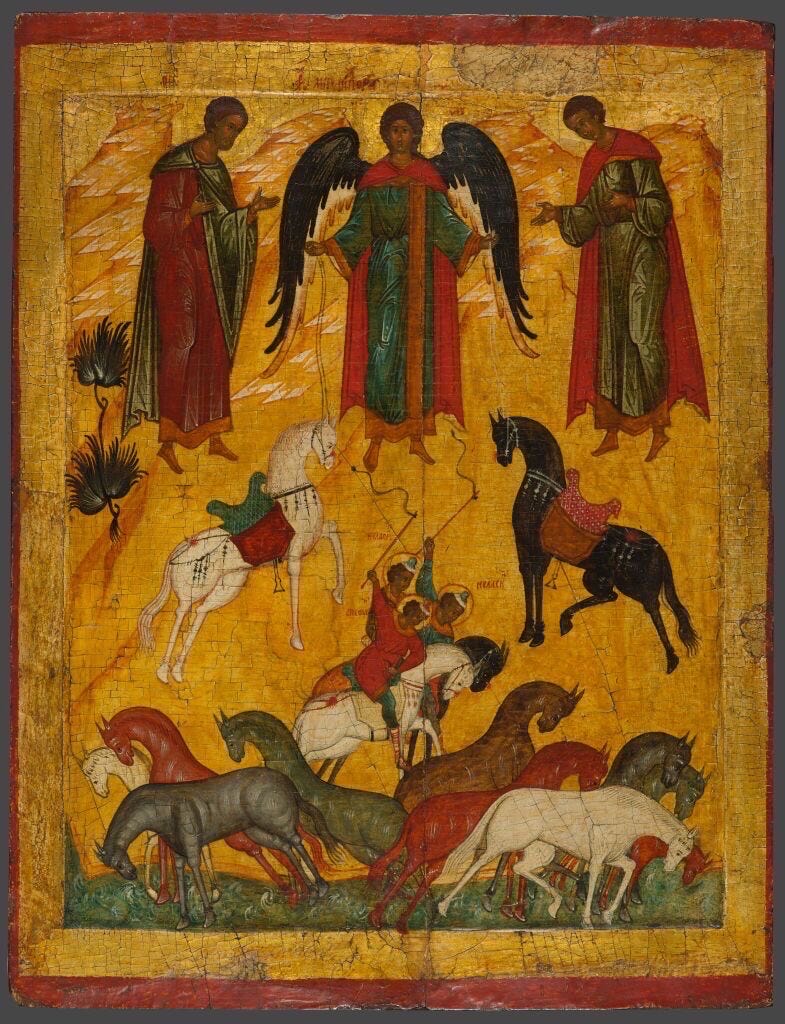
Here they are, as written in the early 1500s. (Ikons are said to be written, not painted, which might inspire us to read them a bit closer than we’re used to.) Notice the colors of the twin brothers’ garments: red-and-green, opposite the green-and-red. Posed in symmetry, not as mutually annihilating opposites, but as complementary forces structuring a relationally-ordered world. (If we like “relationality,” we should perhaps think twice before we do away with “binaries.”) They take a pair of horses by the reins: a white horse, and a black horse, symbols of a theological turn towards a dualist metaphysics in the Bogumil–Cathar vein, for which Novgorod was an important center, certainly comparable to the Balkans or Occitania.
From that Novgorod crux, we would come to see the growth of a dualist metaphysics known as raskol, or the Orthodox schismatic movement which, in its return to the indigenous metaphysics of the region’s earlier shamanic religions, became the home of the Northern tradition of vernacular medicine and healing.
4.
The mystery of the number four, and of the color green as the fourth basic color to emerge, becomes more transparent when we look at the Slavonic etymology of the adjective “green” — zelyony, with its root zel, which means “power.” The Old Slavonic adverb zelo, for example, signifies the high degree and intensity of what is described. Zelo is a Slavonic equivalent of the words “very,” “strongly,” “exceedingly.”
But zelyony is also cognate with the noun zelye, which in modern Russian signifies a kind of witch’s brew or concoction, but historically (as Slavonic zeliye) would have meant simply medicine or power, in the same broad sense as that of the Greek pharmakon. (This is why the ancient notion of “medicine” can apply so broadly, not just to physical bodies but also to life on a larger scale, be it family, community, or the whole society. Each of these progressively larger units, it was understood, need their medicine, and their medicine people.)
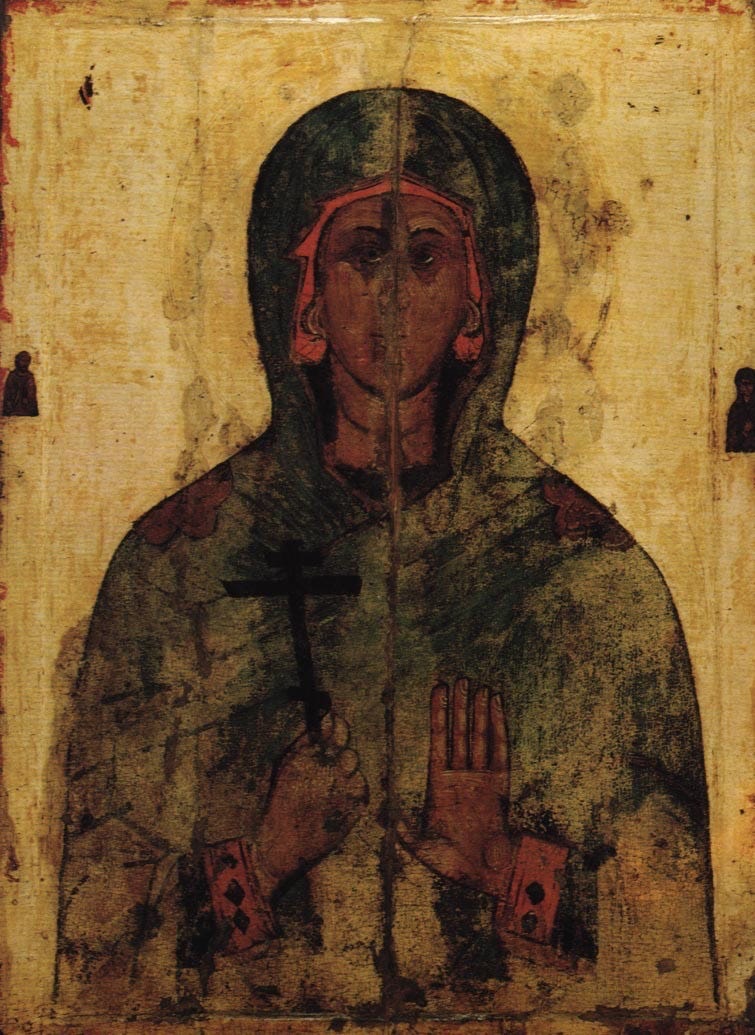
The Pskov ikon of St. Ouliana was written in the late 1300s, or possibly at the very beginning of the fifteenth century. (Note, once again, its Northern provenance, and the rustic rendition of the saint’s name.) Its canonical elements, though, appear settled in a way that suggests it was highly traditional even at the time of its creation. One of them is the green garment worn by the saint…
But which saint are we talking about, exactly? Nominally, this should be St. Juliana of Heliopolis — and yet, there’s nothing in this depiction to distinguish her from another St. Juliana, that of Nicomedia — the patron saint of the sick, also canonically depicted in green, holding up an eight-point cross.
Is it important for us to figure out which saint it is? Well, apparently not — since the painters themselves habitually mixed scenes from both of the two women’s lives when writing the more elaborate, hagiographic ikons. In the popular imagination, however, the various Julianas were but different takes on a certain Ouliana-Deva, or “Ouliana the Virgin,” who possessed the green powers of healing and sustenance.
She, the one in the green garment, was, after all, more ancient than any saint or name. But to this day, those who embark on the path of znakharstvo — of Slavic ritual medicine — are known to make a green home shrine to a certain Green Goddess, the patron deity of High Summer and Herbalists. Here and there known as Ouliana, Juliana, or — most rustic of all — Zhiva.
The life-giving viriditas.
Before you leave…
Did you enjoy this entry? If so, please take a moment to share a few words of response in the comments. This would mean so much, truly, to this fully-human writer!
One more thought...you may find the story of Boshier interesting relative to cave art and color. He entered the African bush at age 16 with only a pocketknife and some salt. Learned to survive, became accepted by tribes and academia, changed how anthropology viewed prehistoric man, then died young. The story is in the book called, Lightning Bird.
Loved it! Found so much to ponder here. This :
"It was on the basis of being able to accommodate these early animistic sensibilities, and of being accommodated by them, that Christianity was able to gradually expand its presence in Slavic and Slavo-Karelian vernacular culture. Not that it was ever wholly accepted: while outwardly deflecting the “light” of Christian religion, its nominal adherents carried on with their “pagan” inward existence, perfectly analogous to the “red stallion” that’s inwardly a “green mare.”"
...really broadened my thinking about your earlier discussion of color and light, absorption and reflection...even the dreaded "binary" :-)
I also found you inclusion of the color-blind seeing 'through' the reflection to be thought provoking and a real strong potion for your whole post.
I'll need to return for more.